
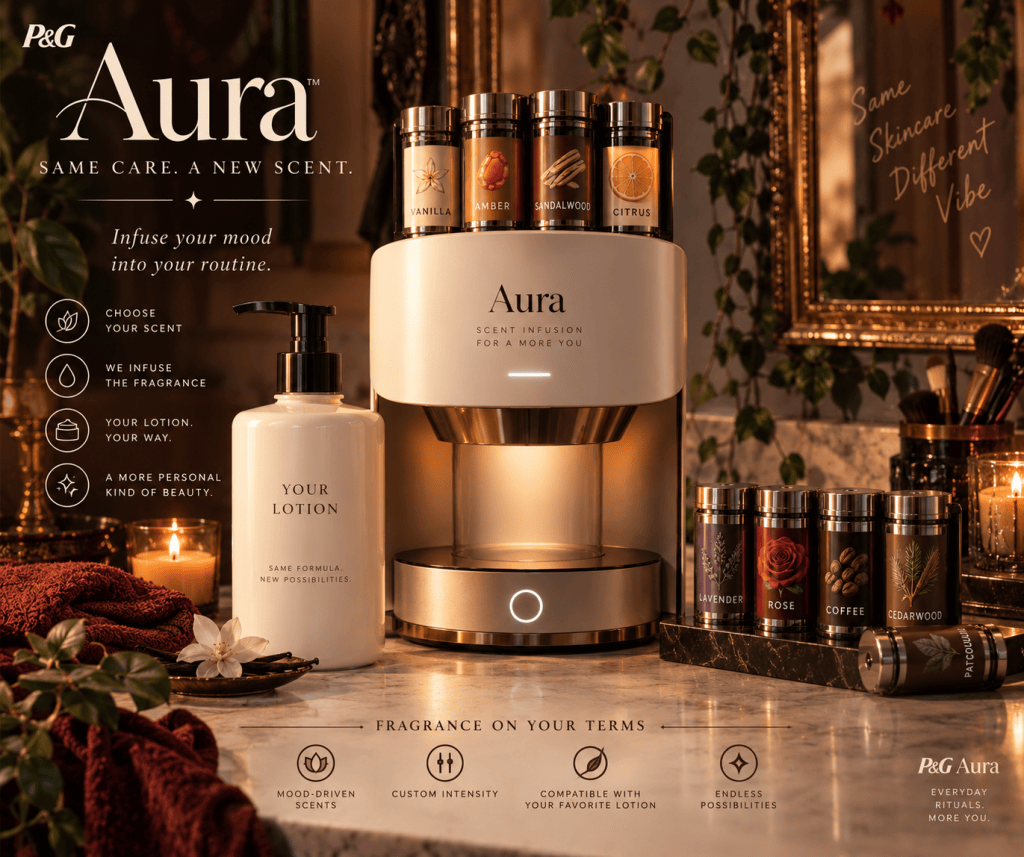
I have always found it interesting that buying body care usually requires a compromise. I might find a lotion that works perfectly for my skin but dislike the fragrance, or love the smell of another product only to discover that the formula itself is not what I want. Why should those two decisions have to be connected? That question inspired my product concept for this project: P&G Aura, a personal body-care fragrance composer.
I selected Procter & Gamble because the company already has a strong presence in beauty and personal care. Its current portfolio includes familiar brands such as Olay, Native, Old Spice, and Secret (Procter & Gamble, 2026). Because consumers already associate P&G with products used in everyday personal-care routines, I think the company could realistically introduce something more experimental without consumers wondering why a completely unrelated company suddenly decided to make a beauty device.
Why P&G?
The beauty industry also continues to place greater importance on personalization. McKinsey & Company (2025) identifies sophisticated consumer insights and hyperpersonalization as increasingly important as traditional consumer segments become more fragmented. At the same time, consumers are paying closer attention to whether beauty products provide enough value to justify their price. Aura would attempt to provide that value through greater control over an everyday product.
Meet Aura
Aura would be a countertop device that allows consumers to personalize the fragrance of a single application of their own compatible unscented or lightly scented body lotion or body oil. Instead of buying an entire bottle of scented lotion and committing to that fragrance, users would add their preferred moisturizer to Aura, select body-safe fragrance concentrates and fragrance intensity, and allow the device to measure and blend the finished application.
Someone might choose vanilla, amber, and sandalwood one day and coffee, caramel, and cedar the next. They could also simply use their moisturizer unscented when they wanted. Basically, your lotion no longer gets to decide your entire personality for the day.
Aura would include a Scent Guide explaining fragrance families, individual notes, suggested combinations, and beginner-friendly recipes. More experienced fragrance lovers could create their own combinations.
Safety would also be an important part of the concept. FDA notes that fragrance ingredients are commonly used in body lotions and that cosmetic companies are responsible for ensuring their products are safe when used as directed (U.S. Food and Drug Administration, 2024). The International Fragrance Association also establishes restrictions and maximum-use levels for certain fragrance materials in finished consumer products (International Fragrance Association, n.d.). Aura would therefore use controlled dosing rather than asking consumers to measure concentrated fragrance themselves.
What Do I Need to Learn?
My primary research objective would be to determine whether U.S. consumers see enough value in customizable body-care fragrance to purchase Aura. I would investigate who is most interested in the concept, how often they currently use body lotion or oil, their fragrance habits, preferred scent families, acceptable price range, and concerns involving sensitivity, compatibility, safety, and replacement fragrance costs.
I would also research competing solutions, including scented body lotions, fragrance layering products, personalized beauty products, and fragrance-mixing technologies. I would compare their pricing, positioning, features, distribution, and promotional strategies. External factors such as cosmetic regulations, economic conditions, beauty technology, sustainability, and changing attitudes toward personalized products would also need to be considered.
Research Design
I would use both secondary and primary research. Secondary research would help evaluate P&G, competitors, industry trends, regulations, and the overall beauty and fragrance markets. Primary quantitative research through consumer surveys could measure purchase intent, price sensitivity, preferred features, and fragrance habits. I would also use qualitative interviews or focus groups to understand why consumers make those choices and what would make them trust—or completely reject—a product like Aura.
Ultimately, Aura is built around a simple idea: consumers should be able to choose how their body care performs and how it smells separately. The research will determine whether consumers think that freedom is useful enough to turn our little countertop potion machine into a viable product.
References
International Fragrance Association. (n.d.). Understanding the IFRA Standards. IFRA Standards
McKinsey & Company. (2025, June 9). The state of beauty 2025: Solving a shifting growth puzzle. McKinsey & Company report
Procter & Gamble. (2026). P&G’s focused portfolio. P&G 2026 Annual Report
U.S. Food and Drug Administration. (2024, February 25). Fragrances in cosmetics. FDA guidance


Leave a Reply